How to Write an AI Creative Brief: A Template for Business Owners
An AI creative brief tells the tool who the work is for, what it must say and which facts support the message. It also specifies the files you need and the checks they must pass.
You can write one without knowing much about design. Start with the facts you are responsible for: the current offer, the real product and any claims you can substantiate. Check those before they enter a script or image.
Use the template below for an image, a short video or a small set of related pieces.
Begin with the buyer's problem
“Make a professional video for our business” leaves the main decision unanswered: why would a potential customer care?
Describe the situation that brings the customer to you. For a repair business, that could be a broken appliance and uncertainty about arranging a visit. Name the person and the question the piece needs to answer.
For example, consider a fictional appliance-repair company, Example Repairs. Its customer is a homeowner who needs a washing machine fixed and wants to understand how a visit is arranged. That is more useful direction than “homeowners aged 25 to 65”. It tells the writer what the person needs to know.
Write one sentence for the audience and one for the problem:
This is for a homeowner arranging a washing-machine repair. They want to know what happens after they ask for a visit.
Attach support questions or sales-call notes if they help establish the problem. Remove names and personal details before sending customer material to an external AI service.
Choose the message and attach its proof
Choose one thing the viewer needs to understand. For this piece, explaining how to request a visit is enough.
For Example Repairs, the message could be: “Request a visit online, then agree a time with the team.” The brief needs evidence that this is how the business works. Attach the booking page and the written confirmation process. If online requests are available only in certain areas, include that condition.
Build a small evidence table:
| Proposed claim | Evidence to supply | Condition to preserve |
|---|---|---|
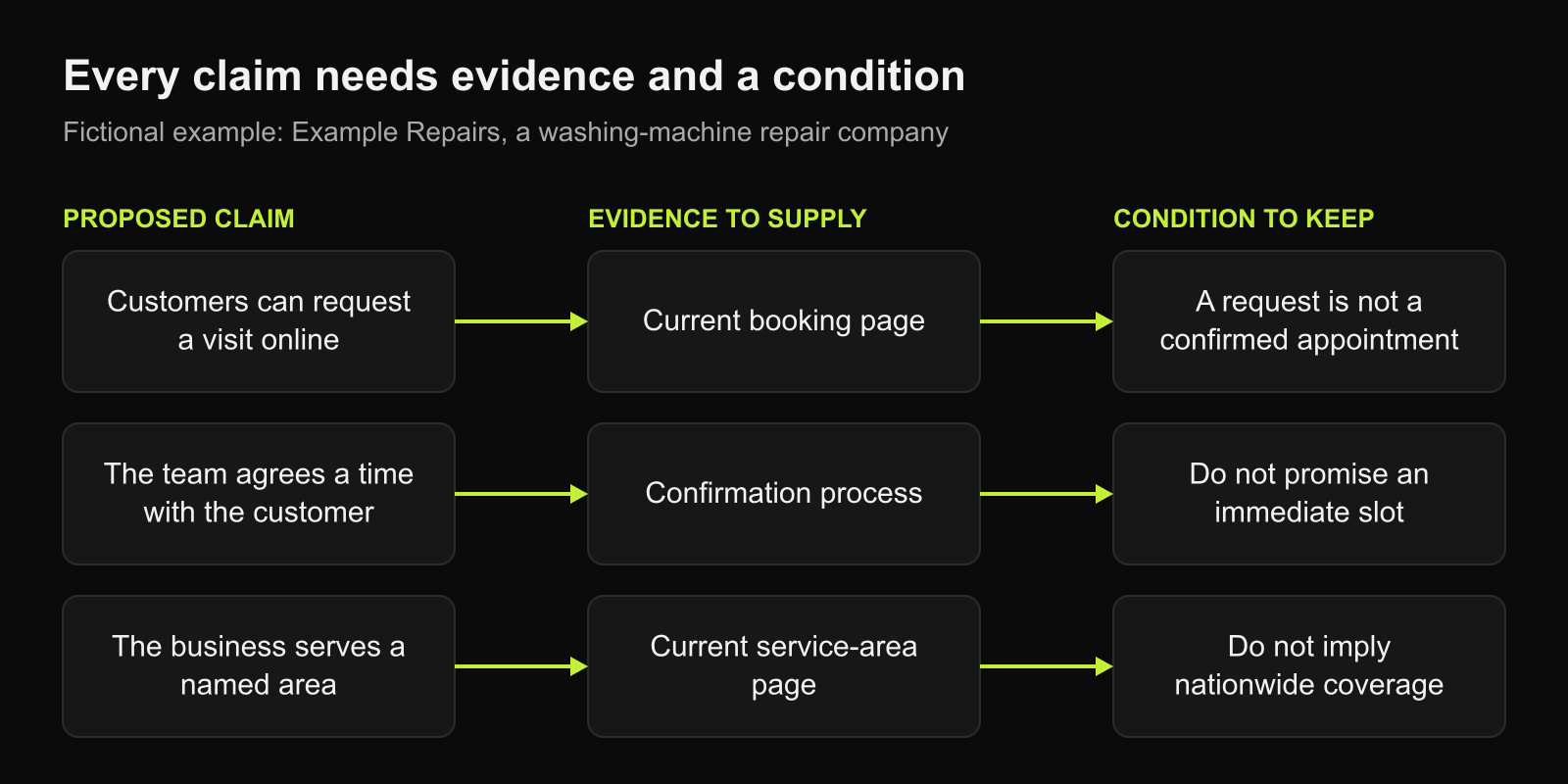
| Customers can request a visit online | Current booking page | A request is not a confirmed appointment |
| The team agrees a time with the customer | Confirmation process | Do not promise an immediate slot |
| The business serves a named area | Current service-area page | Do not imply nationwide coverage |
These are fictional claims for this example. Replace them with your own verified facts. For advertising claims in the United States, the FTC policy statement on advertising substantiation says advertisers need a reasonable basis for objective claims before they make them. Check the rules where you advertise.
Decide what happens when evidence is missing. A useful instruction is: “Ask for the source or leave the claim out.” Without that rule, an attractive sentence such as “same-day repairs guaranteed” can enter the script despite never appearing in your brief. To test a claim against its source, see How to Compare AI Answers Without Mistaking Agreement for Accuracy.
Give each reference a specific job
A reference image might appeal to you because of its colour, framing or typography. Tell the tool which quality you want to use.
Instead of attaching a picture and writing “something like this”, explain what to carry across:
Use this reference for its bright room and large, readable headline. Use our actual logo and supplied washing-machine photograph. The reference's company name and offer are unrelated to this project.
Keep factual assets separate from visual inspiration. Label a real product screenshot as a factual reference. Label another company's advertisement as a style reference. If a screen appears in the finished video, decide whether it must use the supplied screenshot rather than a generated imitation.
Be careful with people's faces, customer messages and assets you do not have permission to use. When the rights are unclear, choose a different reference or ask the owner before including it in the deliverable.
Specify the deliverable
“A video” is not a complete file specification. Give the width, height, duration and file type you need. If you need two shapes, list both.
For a vertical production master, you might request a 1080 × 1920 MP4 lasting 25 seconds. If a 1080 × 1350 version is also required, say whether the composition needs a separate layout or can use scaling and padding. Do not leave the treatment of headlines and product screens to an automatic crop.
These dimensions are production choices for this example, not a claim about every platform's upload requirements. Check the requirements for the intended use before fixing the brief.
Also state whether the piece needs speech, music, captions or an end card. For speech, give the exact spelling of names and any pronunciation guidance. For text that must appear unchanged, mark it as exact copy. If the tool cannot reliably render that text, the plan needs an appropriate composition step before production is approved.
The AdDeck product page lists supported image and video shapes, reference attachments and plans for individual pieces. Use those capabilities to make the requested output explicit.
| Requirement | Record in the brief | Acceptance check |
|---|---|---|
| Format | Image, video or related set | Every requested file is present |
| Dimensions | Exact width and height | Inspect each delivered format |
| Runtime | Approved video duration | Check the full runtime |
| Required message | Approved words and evidence | Compare text and speech with the brief |
Template fields, not a claim about an actual delivered project.
Define the choices you want help with
You do not have to specify every second of a video before asking for a proposal. Decide which choices you want help with.
You might know the audience, message and evidence but want help choosing the scene sequence. Ask for two concepts using the same facts. Or you may already have an approved visual direction and need only a different headline.
Say which decisions are open. For Example Repairs:
Propose a simple scene sequence. Keep the booking process accurate. You may suggest the headline and pacing. Do not add an actor testimonial, a discount or a repair-time promise.
You can then review the proposed scenes and wording before paying for generation.
Adobe's creative-brief guidance includes objectives, audience, messages, deliverables, budget and responsibilities. The evidence and approval fields in the template below adapt those basics to AI-assisted production.
Decide what approval covers
Record the budget for the work and identify the person who can approve a paid step. If the initial generation fails, does that approval cover another attempt? If there are several pieces, does it cover all of them or one first example?
Be explicit. “Show the price for one video and wait for approval” is different from “Make six videos within this total budget.” An unused balance is not automatically permission for another attempt.
The AdDeck page describes price review before paid steps. Read the proposed plan and price together. A correctly priced job can still contain the wrong scene, unsupported copy or an unnecessary generation. For what each kind of charge covers, see Free AI Software, Paid AI Services.
Keep production approval separate from acceptance of the finished file. Agreeing to pay for a generation does not mean accepting whatever it produces.
Write acceptance criteria you can check
“Make it engaging” expresses a preference but gives the reviewer no clear decision rule. Add criteria that can be checked against the actual file.
For the repair-company example:
- The file has the agreed dimensions and duration.
- The voice says “request a visit”, rather than claiming an appointment is already confirmed.
- The booking screen uses the supplied asset and shows no invented controls.
- The headline remains readable wherever it appears.
- The logo and contact details match the supplied originals.
- Every scene is reviewed, including transitions and the final frame.
Passing these checks means the file matches the brief. Whether it persuades customers needs evidence from its actual use.
When requesting a correction, point to the failure. “At 12 seconds the headline is cut off” gives a clear instruction. “This doesn't feel right” needs a further decision about what should change.
Define acceptance before generation so feedback can point to a specific unmet requirement.
Copy this brief template
Project:
Business and website:
Person approving the work:

Audience:
Describe the customer and the situation they are in.

Customer problem:
What are they trying to resolve?

Main message:
What one thing should they understand?

Evidence:
List each claim, its source and any condition that must stay visible.
If a claim has no evidence, ask for a source or omit it.

Deliverables:
Number of pieces:
Dimensions of each:
Duration, if video:
File types:
Speech, music, captions and exact on-screen copy:

Factual assets:
Logo, product screenshots, photographs and current offer details.

Style references:
For each reference, explain which visual qualities it demonstrates.

Decisions open to proposals:
State where you want the tool to suggest an approach.

Do not invent:
List prohibited claims, screens, quotations, people or offers.

Budget and approval:
Maximum production spend:
Who approves each paid step:
Whether another attempt is included:

Acceptance criteria:
List the checks the finished file must pass.

Deadline:
Before handing over the brief, check it for facts you have left unstated. Add the booking conditions, missing asset or exact wording someone else would need. Then review the proposed production plan before work begins.
Citations (2) showhide
- Federal Trade Commission. FTC policy statement on advertising substantiation
- Adobe. Adobe's creative-brief guidance